Key takeaways
- Tailor your resume to every job ad instead of reusing one template.
- Target the right roles rather than applying for everything.
- Build local exposure with a passion project in an in-demand industry, like banking.
- Share your CV with your network to get referrals.
- Volunteering and networking events can lead to real jobs and recruiter contacts
- Know every line of your resume; interviewers will ask about it.
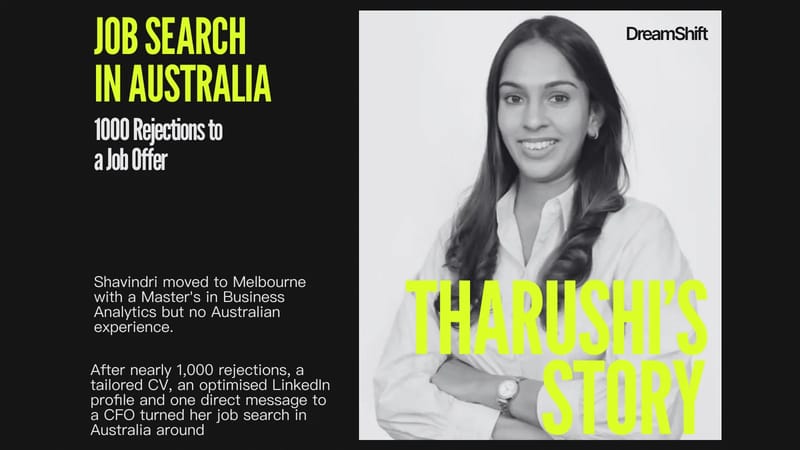
Here is Tharushi’s story!
Tharushi Kaushani began her career in Sri Lanka as a Software Quality Engineer, building over 3 years of experience in software quality assurance.
She later migrated to Australia on a dependent visa and faced the challenge of restarting her career in a new country.
After many rejections and with no Australian experience, she landed a job as a QA Automation Analyst in Brisbane.
Here's how she got there, in her own words.
Q1: Tell us about the challenges you faced applying for jobs in Australia at the beginning.
The biggest challenge was creating a resume that worked for the Australian job market and applying for the right roles. I was writing my own resume and using it for every job, I even did this for my husband. Until I met the DreamShift team, I didn't know how to tailor my resume to the jobs I was applying for.
I applied for everything on SEEK and LinkedIn, telling myself I just needed to find a job somehow. I didn't realise I was undervaluing myself by applying for anything and everything.
Using the same resume template for every job, and applying without any real targeting, made my job search a lot harder than it needed to be.
Q2: What was the turning point, and what changed once you started working on it differently?
I got a proper, personalised upskilling plan from the team, covering everything from CV optimisation to job search strategy.
As a first step, I took on a passion project the team recommended. I had experience in QA engineering, DCRM projects and embedded systems, but no experience in the finance or banking sector. When I looked at job opportunities in the Australian market, I saw many openings in banking, so I built a banking test tracker covering manual, performance, and automation testing. That gave me real exposure to that part of the Australian job market.
Secondly, I used the referral method, which helped me build confidence in finding jobs. I shared my CV with people in my network.
Thirdly, I joined volunteering programs and networking events, even though I was hesitant at first. I trusted the process and went for both short-term and long-term programs. I even landed a QA role through one of the volunteering programs, and met managers, recruiters and administrators through networking events. The team also helped me stay active and visible on LinkedIn throughout.
During one of my interviews, I mentioned this experience, and it clearly impressed the recruiters, especially during salary negotiation. The Australian job market really does expect candidates to have local exposure, and this is how I built mine.
Q3: How many jobs did you apply for, and how did you manage your time to take on these programs and projects at once?
It was intense. I was applying for around 20 to 25 jobs a day, though some days it was just 1 or 2. Luckily, I was working part-time for a Sri Lankan company from my previous workplace, which gave me some flexibility. Volunteering programs usually only ran once or twice a week, or sometimes once a month, which made it easier to fit everything in.
Q4: How was your mental health as a migrant?
It was really tough. Being away from home and without a job as a migrant left me feeling frustrated. The toughest part was the instant rejections, which frustrated me. But I had the determination to keep going. Staying active through volunteering and networking helped keep my mental health steady, even though managing everything at once wasn't easy. I'd recommend migrants join more volunteering programs while job hunting.
Q5: Tell us about the differences between recruiter calls and technical interviews with contractors.
Recruiter calls usually start with where you're based in Australia and your visa status, then move into your project experience, especially around automation and manual testing. In one interview, the interviewer went through my resume line by line and asked me to explain exactly what I'd written; that's when I realised how much the details on your resume actually matter.
Technical interviews with contractors were more focused on technical depth and how I approached problems, but they also cared about attitude, specifically how I'd fit into an Australian workplace. Across both, honesty was the easiest way through. Interviewers want to see what you've actually done, not what you think they want to hear.
Q6: Any tips for freshers applying for jobs in Australia?
Get as much experience as you can, even short-term, and always mention it on your resume. Keep your LinkedIn updated. Don't lose sight of your goal, and keep applying even when it's hard. Stay on top of what's happening in the Australian job market. It moves fast.
It was a lovely interview with Tharushi. Her story reminds us that with the right guidance and real commitment, dreams like hers are possible.
So, if you're struggling to find a job in Australia, don't give up after the first try. We're here to guide you.
FAQ
Can I get a QA job in Australia without Australian work experience?
Yes, but it's harder. Most employers want local exposure. You can build it through volunteering, networking events and passion projects related to Australian industries, like banking.
Can I use the same resume for every job in Australia?
No. Australian employers and screening systems look for keywords from the job ad. Tailor your resume for each role, especially your skills and project sections.
Is it hard to get an IT QA job in Australia?
It can be, because the market is competitive and many applicants have local experience. Targeting the right roles, tailoring your resume and building local exposure make a big difference.
Does networking help with finding a job in Australia?
Yes. Networking helps you meet managers and recruiters directly and opens doors to referrals. Tharushi met managers, recruiters and administrators at networking events while job hunting.